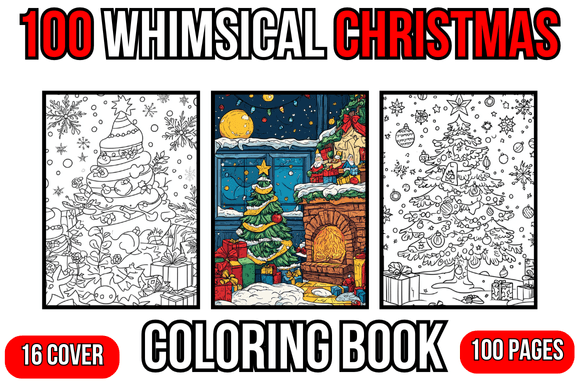
100 Whimsical Christmas Coloring Book
If you're looking for a design asset that balances charm, versatility, and commercial flexibility—especially around the holidays—the 100 Whimsical Christmas Coloring Book stands out not as just another printable, but as a thoughtful, ready-to-deploy creative resource. It’s not a font—it’s a curated collection of 100 original black-and-white illustrations, each drawn with expressive line work, gentle curves, and intentional negative space. Think hand-drawn ornaments floating mid-air, reindeer with floral antlers, snowmen wearing tiny bow ties, and gingerbread houses with crooked chimneys—not stiff clipart, but illustrations with personality and breathing room.
More Than Just Pages—It’s a Creative Launchpad
This isn’t a static coloring book in the traditional sense. It’s a digital printable toolkit designed for reuse across multiple formats and audiences. The 100 Whimsical Christmas Coloring Book includes 16 unique cover images—each one distinct in composition and mood—so you’re never locked into a single visual identity. Whether you're assembling a physical coloring book for Amazon KDP, designing holiday cards for a small stationery shop, or creating limited-edition prints for Etsy, these pages give you consistent tone without sacrificing variety.
The A4 / 8.5×11″ sizing is deliberate: it fits standard home printers, professional copiers, and most print-on-demand services without cropping or scaling compromises. And because all pages are high-resolution black-and-white line art, they reproduce cleanly on everything from matte cardstock to ceramic mugs, cotton tees, vinyl stickers, and even laser-etched wooden ornaments.
Where This Design Language Fits Best
The whimsical aesthetic works precisely where polished minimalism falls flat: in contexts that benefit from warmth, approachability, and subtle storytelling. You’ll see strong resonance in editorial design for lifestyle blogs (think holiday gift guides or cozy winter recipes), packaging for small-batch chocolates or handmade soaps, and social media graphics for craft-based businesses. It’s also highly effective in branding for boutique holiday markets, pop-up shops, or local makers’ collectives—where authenticity and tactile appeal matter more than corporate sheen.
Unlike rigid vector icons or overused seasonal motifs, these illustrations invite reinterpretation. A single page—a wreath made of tangled holly and tiny bells—can become a logo mark, a repeating pattern on wrapping paper, or the central motif on a mug. That flexibility makes the 100 Whimsical Christmas Coloring Book especially valuable for designers who juggle multiple clients or product lines during peak season.
Real-World Usage Notes for Entrepreneurs & Creators
- For Amazon KDP publishers: Use the 16 covers to test different audience angles—“Cozy Christmas,” “Whimsy & Wonder,” “Quiet Holiday Moments”—without redrawing anything. Pair interior pages with light serif body text (e.g., Merriweather or Lora) for contrast and readability.
- For apparel & merchandise: Isolate individual elements (a single snowflake, a curled ribbon, a candle with wavy flame) and scale them thoughtfully. Avoid cramming full scenes onto small items like socks or enamel pins—simplify first, then adapt.
- For digital content creators: Layer colored versions of completed pages behind transparent text overlays for Instagram carousels or Pinterest pins. The line weight holds up well when overlaid with soft gradients or textured backgrounds.
- For educators or therapists: These aren’t just decorative—they support fine motor development and mindful focus. The balance of detail and open space gives adults room to breathe while staying engaged.
Design Integrity Meets Commercial Practicality
What sets this collection apart isn’t just quantity—it’s consistency of voice. Every illustration shares the same underlying rhythm: slightly uneven strokes, organic spacing, and intentional imperfection. That cohesion means your final products feel unified, whether you’re printing 50 coloring books or licensing the art for a café’s holiday menu. There’s no jarring shift in line weight or perspective between pages—no “this one was rushed” energy. That reliability matters when building trust with repeat buyers or wholesale partners.
And yes—you can use it commercially. No attribution required. You’re free to print, repackage, digitize, embroider, or screen-print these designs. That includes selling physical goods (like mugs or tote bags) or digital derivatives (like Canva templates or Procreate brushes built from the outlines). Just keep in mind: the value isn’t in hoarding the files—it’s in how thoughtfully you reinterpret them for your audience’s context.
A Note on Pairing & Presentation
Because these are line drawings—not fonts—the real pairing decisions happen in layout, color, and material choice. When designing a cover using one of the 16 included options, avoid competing typefaces. A clean sans serif (like Poppins or Inter) provides quiet contrast; a delicate serif (Cormorant Garamond, EB Garamond) adds vintage elegance. Avoid script fonts unless they’re extremely restrained—whimsy shouldn’t tip into clutter.
Also worth noting: the black-and-white foundation gives you total control over tone. Print on cream paper for warmth. Use metallic ink on dark stock for luxury appeal. Add spot UV to a single ornament on a greeting card for tactile surprise. The artwork doesn’t dictate your finish—it enables it.
Why This Fits Right Now
Consumers—and especially adult colorists—are moving past mass-produced holiday themes toward experiences that feel personal, handmade, and quietly joyful. The 100 Whimsical Christmas Coloring Book meets that shift head-on. It doesn’t shout. It invites. It leaves room—for color, for interpretation, for pause. And for creators, it removes friction: no need to source disparate assets, negotiate licenses, or redraw basics. You get cohesion, clarity, and creative runway—all in one download.
If you’ve already explored other holiday-themed design assets, you know how quickly repetition sets in. This collection avoids that trap by leaning into variation within unity: different compositions, scales, and focal points—but always with the same gentle, unhurried sensibility. That’s rare. And useful.