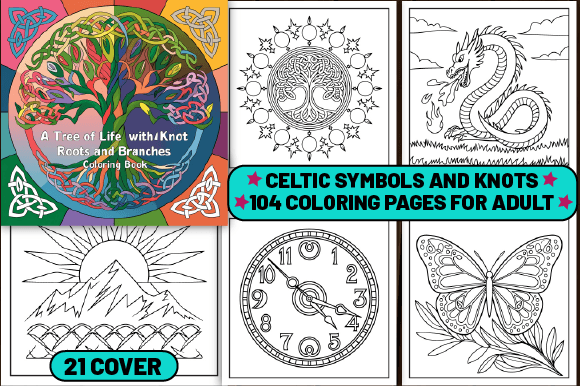
104 Celtic Symbols and Knots Color Pages
The 104 Celtic Symbols and Knots Color Pages is a digital printable coloring book designed for adults, featuring 104 original line-art illustrations rooted in traditional Celtic visual language. Each page presents a distinct symbol—such as the Trinity knot, Tree of Life, Dara knot, spiral motifs, Celtic crosses, and interlaced animal forms—rendered with consistent line weight and balanced negative space to support both precision and expressive coloring. The collection includes high-resolution PDF, JPG, and PNG files (300 dpi), formatted to standard 8.5×8.5-inch dimensions for easy printing on common paper sizes. Additionally, the bundle includes 21 professionally designed book cover templates in PNG format, also at 300 dpi, intended for use on platforms like Amazon KDP or Etsy.
This resource is intended primarily for creators, educators, therapists, and hobbyists who seek ready-to-use, culturally grounded coloring content. It is not a historical reference guide or an art instruction manual; rather, it functions as a production-ready asset pack for those building print-on-demand products, classroom materials, or personal wellness tools.
One reason someone might consider the 104 Celtic Symbols and Knots Color Pages is its practical scope: 104 unique designs offer substantial variety without requiring illustration work. The inclusion of multiple file formats (PDF, JPG, PNG) supports different workflows—PDF for direct printing, PNG for transparent-layer editing, and JPG for broad compatibility. The 21 cover options provide flexibility for branding or platform-specific formatting, especially useful when preparing listings where visual presentation affects discoverability.
A key benefit lies in time efficiency. For independent publishers or small studios, sourcing, commissioning, or generating this volume of culturally resonant, print-ready line art would typically involve significant design labor or licensing fees. This bundle eliminates that step. Its consistent 300 dpi resolution meets industry standards for physical printing, and the square aspect ratio simplifies layout decisions for both interior pages and covers.
However, there are tradeoffs to consider. The product description states these are AI-generated illustrations. While many meet technical quality expectations—clean lines, balanced density, and scalable vector-like clarity—some users may notice subtle inconsistencies in knot continuity, symmetry, or motif authenticity across the full set. Traditional Celtic art relies heavily on precise repetition, directional flow, and symbolic proportion; AI tools do not inherently understand these conventions, so occasional deviations may occur. Reviewing sample pages before purchase is advisable to assess alignment with personal or professional standards.
Another consideration is cultural context. The symbols included draw from Irish, Scottish, and broader Insular artistic traditions—but the coloring pages themselves do not include explanatory text about meaning, origin, or regional variation. Users seeking educational depth will need to supplement with external resources. Likewise, those intending to market the book with interpretive claims (e.g., “each knot represents a specific spiritual concept”) should verify accuracy independently, as the bundle does not provide attribution or scholarly notes.
The 104 Celtic Symbols and Knots Color Pages is a strong fit for individuals or businesses focused on execution over interpretation. It suits creators launching a KDP coloring book who want a cohesive, themed interior without hiring an illustrator. It also supports mental wellness practitioners incorporating structured creative activities into sessions—especially where symbolic resonance (rather than strict historical fidelity) is the goal. Educators using visual culture as a gateway to discussions of heritage, pattern, or geometry may find the designs accessible for introductory projects.
Conversely, alternatives may be preferable in certain cases. Artists or designers prioritizing stylistic uniqueness or hand-drawn texture may prefer commissioning custom illustrations or selecting from curated human-made collections—particularly those vetted by Celtic studies scholars or traditional craft practitioners. Similarly, users needing editable vector files (e.g., SVG or layered AI files) for advanced customization will find the provided PNG/JPG/PDF formats limiting. Those requiring accessibility features—such as high-contrast variants, simplified versions for motor-skill considerations, or multilingual labeling—will need to adapt the files manually or seek specialized resources.
It’s also worth noting the licensing scope. The description states “You can sell on it anywhere,” but buyers should confirm whether the license permits commercial redistribution *as-is*, or only as part of a transformed end product (e.g., a printed book with added value such as introductions, commentary, or layout enhancements). Standard digital product licenses often restrict reselling raw files directly. Clarifying permitted use cases aligns expectations with actual legal boundaries.
Practically, evaluating whether this bundle matches your goals starts with defining your primary use case. Ask: Is my priority speed-to-market, thematic consistency, or symbolic authenticity? If the first two outweigh the third, the 104 Celtic Symbols and Knots Color Pages offers a functional solution. If you require scholarly rigor, bespoke aesthetics, or flexible file types beyond raster formats, investing time in alternative sources—or combining this bundle with supplemental research and editing—may yield better long-term results.
Finally, consider workflow integration. Because all 104 pages are delivered in standardized dimensions and resolution, they integrate smoothly into automated publishing pipelines. However, if your process relies on batch-editing tools that require uniform layer structures or metadata tagging, the lack of embedded information (e.g., symbol names, source references, or color guidance) means additional manual organization may be necessary.
In summary, the 104 Celtic Symbols and Knots Color Pages serves a specific niche: efficient, scalable access to thematically unified, print-ready line art. Its value emerges most clearly when matched to goals centered on production practicality—not cultural scholarship, artistic distinction, or technical versatility. Readers weighing this resource should anchor their decision in how it fits within their broader objectives, constraints, and standards—not in generalized assumptions about what “Celtic coloring” ought to deliver.