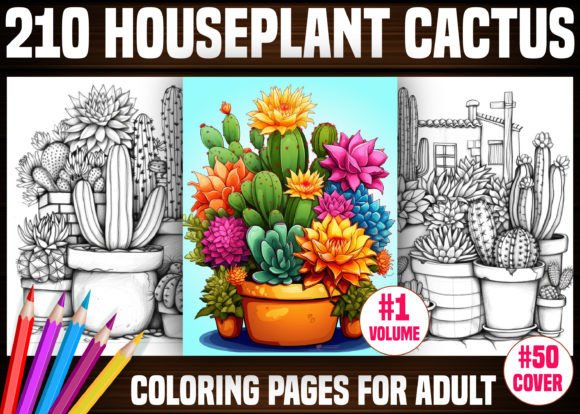
210 Houseplant Cactus Coloring Pages-KDP
What if you could launch a professionally formatted, print-ready coloring book in under an hour—without drawing a single line? That’s exactly what 210 Houseplant Cactus Coloring Pages-KDP delivers: a complete, high-resolution interior package designed for creators who want to publish confidently on Amazon KDP. It’s not just a collection of images—it’s a tested, production-ready toolkit built around one calming, on-trend theme: houseplant and cactus illustrations.
More Than Just Pages—It’s a Publishing Foundation
This resource includes 210 unique black-and-white line art pages, all sized at 8.5″ × 11″ and rendered at 300 DPI—ensuring crisp, clean prints whether used digitally or on physical paper. Every page is available in three formats: PDF (single print-ready file), JPG, and PNG—giving you flexibility across design tools, platforms, and workflows. You also get 50 cover-ready PNGs, each at 300 DPI and fully resizable without quality loss. No cropping, no pixelation, no guesswork.
Unlike generic clipart bundles or low-res downloads, this set was developed with Amazon KDP’s technical requirements in mind. Margins, bleed areas, and resolution thresholds were validated during real-world uploads—so your book passes KDP’s automated checks the first time. That means less troubleshooting, fewer rejected files, and faster time-to-market.
For Beginners Building Their First KDP Book
If you’ve never published before, the biggest hurdle isn’t creativity—it’s confidence in the technical setup. With 210 Houseplant Cactus Coloring Pages-KDP, you skip the trial-and-error phase. The PDF interior is pre-formatted for standard KDP trim sizes. You can import it directly into Kindle Create or upload it as-is. No need to learn InDesign or wrestle with margins. Just pair it with one of the 50 covers, write a simple description, and hit “Publish.” Many new creators use this as their first high-content title—and go live within a day.
For Educators and Therapists
Teachers, counselors, and occupational therapists often seek quiet, grounding activities for students or clients. Cacti and houseplants are gentle, non-intimidating subjects—ideal for mindfulness practice or fine-motor development. These pages offer consistent line weight and clear silhouettes, making them accessible for varied skill levels. You might print individual pages for classroom use, embed them into digital lesson plans, or compile themed sets (e.g., “Succulents for Stress Relief”) for small-group sessions. Because all files are high-resolution and editable via PNG/JPG, you can adjust contrast or size for accessibility needs—like enlarging stems for younger learners or reducing density for sensory-sensitive users.
For Freelancers and Designers
You’re likely juggling tight deadlines and client expectations. When a client asks for a “botanical-themed adult coloring book,” having a vetted, ready-to-brand asset library saves hours. You can layer these PNGs over custom backgrounds, add subtle textures, or integrate them into branded workbooks. The 50 cover options let you rapidly prototype variations—minimalist, vintage, watercolor-textured—to present to clients before finalizing layouts. Since every file is 300 DPI and vector-adjacent in clarity, resizing for social media teasers or Amazon thumbnails stays sharp.
For Small Business Owners and Bloggers
If you run a plant-focused shop, wellness blog, or subscription box service, original content builds trust and differentiates you from competitors. These pages aren’t stock—they’re cohesive, curated, and niche-specific. You might include a free downloadable page in your email newsletter (“This week’s Calm Cactus Coloring Sheet”), turn five favorites into Instagram carousel posts, or bundle 20 pages as a lead magnet. Because you own full commercial rights, there’s no attribution required—and no risk of takedown notices.
For Experienced KDP Publishers
You know how much time goes into sourcing, testing, and formatting interiors. What makes 210 Houseplant Cactus Coloring Pages-KDP valuable here isn’t novelty—it’s reliability. You can batch-process these files using scripts or automation tools. The uniform sizing and resolution mean consistent output across multiple titles. Some publishers use this set as a “base” interior, then swap in 10–15 custom-drawn pages to create a hybrid book—blending speed with personal branding. Others split the collection across themed volumes (“Desert Dwellers,” “Indoor Jungle,” “Tiny Terrariums”) to build a series without redrawing everything from scratch.
What to Consider Before You Use It
Your goals shape how you’ll engage with this resource. Ask yourself:
- Ease of use? If you prioritize speed and simplicity, the PDF interior is plug-and-play. No design software needed.
- Customization depth? If you plan to edit, recolor, or composite, the PNG and JPG files give you full layer control in tools like Photoshop, Canva, or Affinity Designer.
- Commercial scale? You’re cleared to sell unlimited copies on KDP—and reuse the assets across multiple books, courses, or printables. No recurring fees or licensing caps.
- Long-term value? Because the theme is evergreen (indoor plants remain popular across seasons and trends), these pages stay relevant year after year—not tied to fleeting holidays or fads.
One practical note: while the line art is clean and consistent, it’s intentionally hand-drawn in style—not ultra-minimalist or hyper-detailed. That makes it approachable for adults who color casually, but still engaging enough for those who enjoy intricate shading. You’ll find open spaces for blending, defined outlines for precision, and botanical accuracy that feels grounded—not cartoonish.
A Resource That Grows With You
Whether you’re testing your first KDP listing, building a portfolio of therapeutic resources, or scaling a digital product business, 210 Houseplant Cactus Coloring Pages-KDP meets you where you are. It doesn’t assume expertise—but it doesn’t limit growth, either. You can start small (one book, one cover) and expand thoughtfully (series, bundles, cross-platform uses). And because every file is delivered at professional print standards, your output reflects care—even when your process is streamlined.
No two creators use it the same way. A yoga instructor might pair page 47—a monstera leaf with flowing vines—with breathwork prompts. A stationery designer might extract the pot illustration from page 112 and turn it into a greeting card motif. A homeschool parent might print pages weekly as part of a “Botany & Calm” unit study. The consistency of the set lets you focus on purpose—not pixels.
At its core, this is about lowering barriers—not to publishing, but to expression. To learning. To slowing down, even briefly, with a pencil and something green.