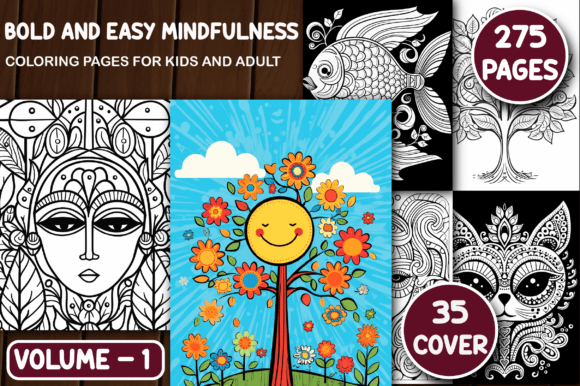
240 Bold and Easy Mindfulness Color Page
If you’ve ever sat down with a coloring book—whether to unwind after a long workday, help a child settle before bedtime, or brainstorm ideas during a quiet morning—you know how grounding bold, clean lines can be. The 240 Bold and Easy Mindfulness Color Page isn’t just another collection of patterns. It’s a practical, ready-to-use toolkit designed for real life: for adults who need mental reset buttons, kids who learn through tactile calm, educators building emotional regulation into lessons, and creators launching low-effort, high-impact digital products.
This digital printable bundle delivers exactly what its name promises—240 pages (plus 35 premium covers) of intentionally bold, easy-to-color mindfulness-themed illustrations. No tiny details that frustrate beginners. No vague themes that leave users guessing. Just clear linework, balanced negative space, and imagery rooted in presence—think breathing circles, grounded trees, gentle waves, mindful hands, and abstract mandalas shaped around breath and stillness.
Where This Fits Into Real Routines
Coloring isn’t just “for kids” anymore—and it’s not just a hobbyist pastime. People use these pages in ways that reflect actual needs:
- A freelance designer downloads the PNG files, drops them into Canva, adds custom fonts and branding, and turns one page into a lead magnet for her email list—“Download Your Free Mindful Minute Coloring Sheet.” She uses three others as Instagram Story backgrounds during client onboarding calls to soften the tone of her virtual meetings.
- A middle school counselor prints six pages weekly and uses them during small-group check-ins. Students choose one image that matches how they’re feeling—no talking required. Later, she scans completed sheets and shares anonymized versions (with permission) in staff PD sessions on nonverbal emotional expression.
- A solopreneur launching a KDP coloring book uploads the full 275-page PDF directly to Kindle Direct Publishing. She swaps out the included cover options until she finds one that aligns with her brand palette, adds a short intro about mindful coloring for busy adults, and publishes in under two hours—no illustration software needed.
- A parent of a neurodivergent 8-year-old prints a few pages each Sunday, trims them to fit a small travel binder, and keeps them in the car. When waiting at appointments or needing a sensory break during errands, the thick lines and predictable shapes help regulate without screen time or verbal negotiation.
Why “Bold and Easy” Actually Matters
“Bold” here isn’t just visual—it’s functional. Thick outlines reduce eye strain, support fine motor development in younger kids, and allow confident coloring even with markers, gel pens, or crayons that bleed. “Easy” means intuitive flow: no confusing overlaps, no ambiguous shapes that make users pause and second-guess. That predictability builds confidence—not just in coloring, but in the act of pausing. You don’t need to “get it right.” You just need to show up, pick a color, and follow the line.
That simplicity is especially valuable when attention is fragmented—like during lunch breaks between Zoom calls, while waiting for a toddler’s nap to start, or when recovering from decision fatigue. One user told us she prints a single page every Monday, tapes it beside her laptop, and colors five minutes before opening email. “It’s my ‘buffer zone’—not meditation, not journaling, just *line + color + breath*.”
What You’ll Actually Get (and What to Keep in Mind)
The bundle includes 275 JPG, PNG, and print-ready PDF files—all sized for A4 and US Letter (8.5×11″), all at 300 dpi. That means crisp output whether you’re printing at home, sending to a local copy shop, or uploading to KDP, Etsy, or your own Shopify store. The 35 cover designs give flexibility: test different moods (serene vs. vibrant), audiences (adult-focused vs. family-friendly), or niches (anxiety relief vs. classroom tools).
These are AI-generated—but not in the “generic stock art” sense. Each design was refined in Adobe Illustrator, so lines are smooth, spacing is consistent, and scalability holds up. That said, minor imperfections may appear—like a stray anchor point or a slightly uneven curve. If you’re using these commercially and want pixel-perfect polish, plan 10–15 minutes per file in Illustrator or Affinity Designer to clean up what matters most for your use case. Most users skip this entirely—and still get excellent results.
Who Benefits Most—and How
Educators use these to scaffold social-emotional learning—coloring a “calm corner” poster together, then discussing what “calm” feels like physically. No lesson plan required; the image does the inviting.
Content creators turn individual pages into Pinterest pins (“Mindful Coloring Prompt: Trace the Circle While Taking 3 Slow Breaths”), embed them in Notion templates, or layer them behind voiceover videos for YouTube Shorts about focus and nervous system regulation.
Small business owners bundle 10 pages with a paid workshop (“Mindful Marketing Bundle”) or include one as a free download with newsletter signups—building trust while offering immediate value.
Everyday users keep a printed stack in their bedside drawer. On nights when sleep won’t come, they grab one page, a pencil, and color slowly—no goal, no timer, just movement and line. It’s not about finishing. It’s about interrupting the loop.
Before You Download: A Few Practical Notes
You own full commercial rights—so yes, you can sell finished books, offer them as digital downloads, or embed them in courses. But remember: if you’re reselling as-is, consider adding your own voice. A short intro explaining *why* mindfulness and coloring pair well for your audience? A quick tip on using colored pencils vs. markers? That human touch builds connection far beyond the line art.
If you’re printing at home, test one page first—especially if using thicker paper or certain inkjet printers. The bold lines hold up well, but absorption varies. And if you’re sharing with kids under 7, preview a few pages for theme appropriateness (e.g., some nature-based images include subtle animal forms—gentle, but worth scanning).
Finally, don’t overthink “perfect usage.” One teacher printed 20 copies of the same breathing circle page and used them for six weeks straight—students colored it differently each time, sometimes silently, sometimes while listening to guided audio. Consistency, not variety, created the calm.
The 240 Bold and Easy Mindfulness Color Page works because it meets people where they are: tired, distracted, pressed for time, or quietly searching for something steady. It doesn’t ask for commitment. It offers invitation—thick lines, quiet themes, and the simple permission to begin again, one color at a time.