250 Cute Baby Dragon Coloring Pages KDP
Coloring isn’t just for kids anymore—it’s a quiet revolution in creative entrepreneurship, therapeutic practice, and digital publishing. At the center of this shift is practical, high-quality, ready-to-use content like 250 Cute Baby Dragon Coloring Pages KDP. This collection isn’t another generic set of clipart-style line drawings. It’s a thoughtfully structured, production-ready interior package built for creators who value speed without sacrificing quality—especially those publishing on Amazon KDP or designing activity kits, classroom resources, or branded merchandise.
What Makes This Collection Stand Out in Today’s Market?
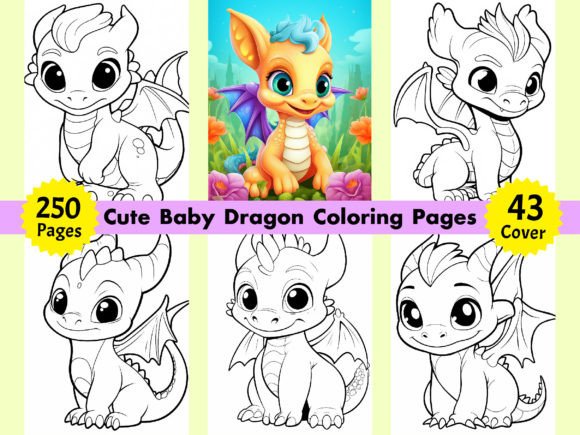
Modern creators face two simultaneous pressures: the need to ship fast and the expectation to deliver polished, professional results. The 250 Cute Baby Dragon Coloring Pages for Kids. Vol 01 directly addresses both. With 250 unique, hand-crafted (though AI-assisted) baby dragon illustrations—each rendered at true 300 DPI resolution—you get print-grade assets that hold up under scrutiny. No pixelation. No jagged edges. No guesswork about bleed or margins. Every image fits the standard 8.5″ x 11″ format, optimized for US letter-size printing and KDP’s interior requirements.
The delivery structure reflects real-world workflow needs: four separate folders—one each for JPG, PNG, PDF, and bonus cover assets. That means no time wasted converting formats or troubleshooting transparency issues. PNG files include clean white backgrounds *and* transparent versions, giving flexibility for digital overlays, merch mockups, or layered design tools. The included PDF is pre-formatted as a single-page-per-sheet layout—ideal for immediate printing or quick review before upload.
Why Baby Dragons? And Why Now?
Dragons have long held cultural resonance—but baby dragons tap into something more specific: warmth, approachability, and gentle whimsy. They’re emotionally accessible without being cutesy to the point of exclusion. Teachers use them to soften STEM-themed lessons (“dragon habitat maps” or “baby dragon life cycles”). Therapists incorporate them into emotion-regulation exercises (“draw your calm dragon”). Parents appreciate characters that feel safe and imaginative—not intimidating or overly complex.
This aligns with broader shifts in consumer behavior. Adults are increasingly seeking low-stakes, analog-adjacent activities that offer control, completion, and tactile satisfaction. Coloring books rank consistently among Amazon’s top-selling categories in Books > Crafts, Hobbies & Home—and titles featuring friendly fantasy creatures outperform generic florals or mandalas in niche search traffic. Search volume for terms like “cute dragon coloring book for kids” and “baby dragon printable pages” has grown steadily over the past 18 months, driven by educators building themed units, indie publishers testing micro-niches, and homeschool families curating custom learning kits.
AI-Generated Doesn’t Mean “Generic” Anymore
There’s still understandable skepticism around AI-generated art—especially in creative markets where authenticity matters. But this collection demonstrates how far the technology has come when paired with skilled prompting, careful curation, and human-led refinement. Each of the 250 designs avoids repetition, maintains consistent linework weight, and preserves intentional negative space—critical for colorability. You won’t find overlapping limbs, indecipherable details, or inconsistent scale. These aren’t algorithmic afterthoughts; they’re purpose-built illustrations designed for a functional outcome: coloring.
That distinction matters for professionals. A freelance graphic designer sourcing assets for a client’s summer camp workbook doesn’t need “artistic expression”—they need clarity, consistency, and legal safety. All images are original, commercially licensed, and free from third-party IP conflicts. You can use them in physical books, digital downloads, lesson plans, social media posts, or even printed party favors—no attribution required.
Practical Use Cases Across Roles
Educators: Integrate individual pages into literacy centers (“label the baby dragon’s scales”), math warm-ups (“count the stars around the dragon’s nest”), or SEL prompts (“what emotion is this dragon feeling?”). The consistent 8.5″ x 11″ size makes them plug-and-play for laminated station cards or interactive whiteboard projection.
KDP Publishers: Upload the PDF directly as your interior file—or mix and match JPG/PNG assets to build custom layouts in Canva or Affinity Publisher. The 43 bonus PNG cover images give you options for front/back/spine combinations without hiring a designer. Since all files are 300 DPI, you avoid KDP’s common “low-resolution warning” during upload—a frequent pain point for new publishers using free online tools.
Small Business Owners: Turn single pages into printable party invites, sticker sheets, or coloring placemats for cafes and libraries. Pair a dragon page with a simple “Happy Birthday” banner and you’ve got an instant themed product. The transparent PNGs work seamlessly in Cricut Design Space or Silhouette Studio for cutting machines.
Bloggers & Content Creators: Use individual dragons as visual anchors in blog posts about mindfulness for children, fantasy-themed learning, or screen-free play ideas. Embedding a high-res PNG (with light watermark if desired) adds visual authority without slowing down page load times—unlike heavy SVG or animated assets.
How This Fits Into Evolving Creative Workflows
Five years ago, assembling a full-coloring-book interior meant outsourcing to illustrators, managing revisions, and waiting weeks for delivery. Today, curated asset packs like this one compress that timeline from weeks to minutes—without compromising on usability. That speed matters not because creators want to rush, but because they’re balancing multiple roles: teacher + marketer + designer + customer service rep. Time saved on asset assembly is time redirected toward audience engagement, distribution strategy, or product iteration.
It also reflects a broader move toward modular creation—building products from interoperable, reusable components. Instead of treating a coloring book as a monolithic project, savvy users treat it as a library: one set of dragons for a “Mythical Pets” series, another for “Fantasy Friends,” a third for “Magical Habit Trackers.” The folder-based organization supports that mindset. Need only the PNGs for a digital download store? Grab that folder. Prepping for print-on-demand? Pull the PDF. Testing cover concepts? The 43 bonus images give you rapid A/B options.
A Realistic Note on Expectations
This isn’t a magic bullet for passive income. Success still depends on thoughtful positioning, accurate categorization on KDP, clear cover design, and genuine understanding of your audience’s needs. But 250 Cute Baby Dragon Coloring Pages KDP removes one significant friction point: the technical and aesthetic labor of illustration. What remains is the strategic work—the kind that actually grows businesses and deepens impact.
It’s also worth noting that “cute” doesn’t mean simplistic. Many of the dragons feature subtle textures (scaly wings, fuzzy ears, embroidered cloaks), varied poses (curled, flying, peeking from clouds), and contextual elements (tiny wands, enchanted scrolls, cozy nests) that invite storytelling—not just coloring. That layer of narrative openness makes the pages equally valuable for speech-language pathologists prompting descriptive language or writers using visual prompts for flash fiction exercises.
Final Thought: Tools Should Serve Intent, Not Replace It
The best creative tools don’t eliminate human judgment—they amplify it. With 250 Cute Baby Dragon Coloring Pages for Kids. Vol 01, you’re not buying 250 pictures. You’re buying 250 opportunities—to engage a child’s curiosity, support a student’s focus, launch a small business experiment, or simply carve out ten quiet minutes in a noisy day. The dragons are cute, yes—but their real value lies in how reliably, flexibly, and professionally they help you meet your goals.