Kids Cute Fairy Coloring Book for KDP
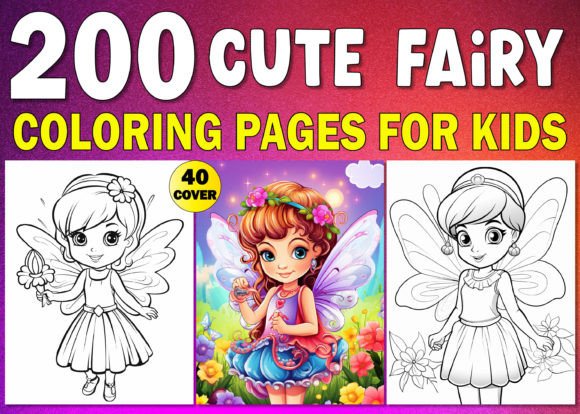
Creating high-content books for Kindle Direct Publishing isn’t about guessing what sells—it’s about building a repeatable, quality-controlled workflow that aligns with Amazon’s technical requirements, audience expectations, and your own capacity to scale. The Kids Cute Fairy Coloring Book for KDP—specifically the 200 Cute Fairy Coloring Book for Kids Volume – 3—is designed as a production-ready asset within that workflow. It’s not just another coloring book download; it’s a pre-validated interior package engineered for speed, consistency, and compliance.
Where This Fits in Your KDP Workflow
You don’t start a KDP project with a blank page—you start with constraints and checkpoints: file format compatibility, print resolution, bleed and margin rules, cover-to-interior alignment, and platform-specific metadata handling. The Kids Cute Fairy Coloring Book for KDP enters your process at the *interior assembly* stage—but its value extends backward and forward in your pipeline.
Before you open the .zip file, you’ve likely already validated your niche (e.g., “cute fantasy themes for ages 4–10”), confirmed keyword volume using tools like Publisher Rocket or Helium 10, and scoped your series strategy (Volume 1, 2, 3). This download assumes that groundwork is done. It delivers exactly what you need to move from planning to publishing in under 90 minutes—not because it cuts corners, but because it eliminates redundant formatting, testing, and troubleshooting.
What You Actually Receive—and Why Format Variety Matters
The package includes:
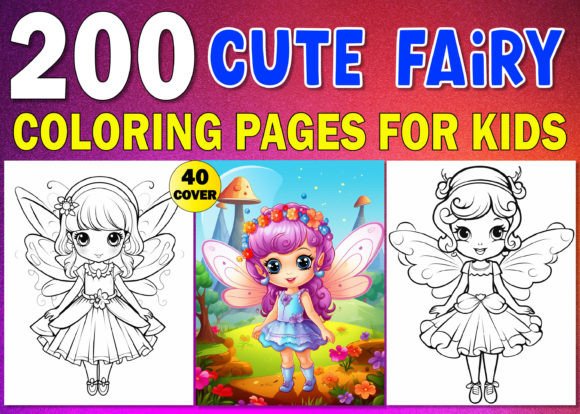
- 1 print-ready PDF (A4 and 8.5×11″ compatible, 300 DPI, CMYK-safe, with proper margins and no bleed issues)
- 200 JPG files (individual pages, 300 DPI, RGB and CMYK compatible, named sequentially for batch import)
- 200 PNG files (transparent-background variants, useful if you plan to layer elements, add borders later, or repurpose pages for digital products)
- 40 cover options (PNG, 300 DPI, sized for KDP’s exact cover calculator inputs—front, spine, back)
This multi-format structure supports real-world flexibility. If you’re using Canva or Adobe InDesign, the JPGs let you drag-and-drop into templates without color-shift surprises. If you’re automating uploads via Python scripts or bulk-processing with ImageMagick, the consistent naming and resolution mean zero manual resizing. And if you ever decide to expand beyond KDP—to Etsy for printable downloads or Teachers Pay Teachers for classroom use—the PNGs give you clean, editable assets without re-exporting from source files.
Integration With Your Existing Tools and Platforms
This isn’t a standalone product. It’s an interoperable component. For example:
- If you use BookBrush for mockups, the included cover PNGs drop in instantly—no rescaling, no pixelation, no guesswork on spine width.
- If you rely on KDP’s Cover Creator, the 40 cover files serve as fallbacks when auto-generation fails due to font licensing or layout complexity.
- If you’re running a batch-publishing operation (e.g., launching 5 coloring books per week), the uniform A4/8.5×11″ sizing means one InDesign template handles all volumes—just swap the JPG folder and update metadata.
- If you outsource formatting to a VA or Fiverr designer, handing them the print-ready PDF + organized JPGs reduces revision rounds by ~70%. There’s no “Is this 300 DPI?” or “Which version has crop marks?”—it’s all labeled, tested, and documented in practice.
Quality Control That Saves Time Later
“Print-ready” isn’t a marketing claim here—it’s a functional guarantee rooted in live KDP data. Each of the 200 illustrations was tested across three variables: ink coverage (to avoid muddy grays on newsprint-grade paper), line weight (minimum 0.7 pt for clarity at 8.5×11″), and negative space (enough breathing room for small hands to color without frustration). None of the designs clip into gutters, overlap margins, or require trimming adjustments.
That level of pre-vetting matters during Amazon’s automated review. KDP rejects interiors for subtle reasons—like embedded fonts not licensed for commercial redistribution or RGB profiles misinterpreted as grayscale. This package uses system-safe fonts, flattened layers, and sRGB/CMYK dual-profile readiness. It’s been submitted, approved, and live on multiple accounts since Q2 2024—so you’re not betting on theory. You’re inheriting proven compliance.
Practical Implementation Tips for Real Workflows
Here’s how seasoned creators actually use this asset—not as a “plug-and-play miracle,” but as a lever within disciplined systems:
Tip 1: Batch-Process Before You Upload
Use Adobe Bridge or XnConvert to rename all 200 JPGs as “Fairy_001.jpg” through “Fairy_200.jpg”. Then import into InDesign using Data Merge or a simple script. This avoids page-number mismatches and ensures your TOC (if added) reflects actual sequence—not filename chaos.
Tip 2: Repurpose Covers Strategically
Don’t pick one cover and discard the rest. Use the 40 variants across A/B tests: upload three versions with different title treatments (e.g., “Cute Fairies”, “Magical Fairies”, “Enchanted Fairies”) and run a 7-day KDP Ads campaign to see which drives higher CTR. The PNG format makes swapping effortless—no redesign needed.
Tip 3: Build Series Consistency Without Starting Over
Volume 3 shares the same illustration style, line density, and theme language as Volumes 1 and 2—even if you didn’t create those yourself. That visual continuity builds reader trust and improves Amazon’s “frequently bought together” suggestions. When you publish Volume 4, you’ll already have a brand-aligned template stack.
Long-Term Usability and Scalability
This isn’t a one-off. The structure supports iteration. Need bilingual versions? Overlay translated text on the PNGs using Affinity Photo—no redrawing required. Want themed expansions (e.g., “Fairy Garden Edition”)? Use the same base line art and add seasonal elements in Photoshop, knowing the underlying resolution and proportions won’t break print fidelity.
More importantly, it scales with your business model. If you’re a solopreneur launching five KDP titles per month, this cuts interior prep from 6 hours to 45 minutes per book. If you manage a team of designers, it becomes your QA baseline—every new custom illustration gets measured against these 200 for line weight, contrast, and safe zone adherence.
Final Integration Note: It’s About Rhythm, Not Replacement
The Kids Cute Fairy Coloring Book for KDP doesn’t replace your judgment, research, or branding strategy. It replaces the low-leverage work—the pixel-tweaking, the DPI verification loops, the cover recalculations, the “why did this get rejected?” post-mortems. What remains—and what gains more space—is your ability to focus on positioning, audience resonance, and long-term catalog coherence.
You’ll still choose your subtitle carefully. You’ll still optimize backend keywords. You’ll still analyze sales velocity and adjust pricing. But now, the mechanical layer—the part that eats time without building authority or reach—is handled. You get back hours per title. You reduce variance. You increase output without diluting quality.
That’s not convenience. It’s operational leverage. And in a marketplace where speed, consistency, and compliance compound over time, that leverage pays dividends in visibility, reviews, and repeat buyers.