Kids Math Addition with 5 Worksheets: A Thoughtfully Designed Learning Resource for Real-World Skill Building
Teaching foundational math concepts to young learners requires more than repetition—it demands clarity, visual engagement, and pedagogical intention. Kids Math Addition with 5 Worksheets reflects this understanding by offering a cohesive, classroom-tested set of materials designed not just for practice, but for meaningful cognitive development. Unlike generic printables that prioritize volume over structure, this collection is built around progressive skill scaffolding—starting with single-digit sums and advancing thoughtfully toward mixed addends, visual modeling, and early problem-solving contexts.
Why Structured Repetition Matters in Early Numeracy
Research in early childhood education consistently shows that consistent, well-paced exposure to number relationships strengthens neural pathways associated with quantitative reasoning. Children don’t learn addition through isolated facts alone; they internalize it through pattern recognition, spatial representation, and repeated contextual application. The five worksheets included in Kids Math Addition with 5 Worksheets are sequenced to mirror this developmental arc. The first sheet uses concrete objects—apples, stars, blocks—to illustrate “counting on.” The second introduces number lines as tools for mental strategy. By the third, students transition to abstract numerals with intentional spacing and font sizing to reduce visual fatigue. Each subsequent page adds subtle complexity: missing addends, commutative property prompts, and real-life word scenarios like “Lily has 3 stickers and gets 4 more—how many now?”
Design Integrity Meets Practical Classroom Needs
Educators and caregivers often face a trade-off between aesthetic appeal and functional utility. Bright colors may capture attention, but poor contrast or cluttered layouts can impede focus—especially for neurodiverse learners or those developing fine motor control. These worksheets avoid that pitfall. Every element serves a purpose: generous margins support cutting and pasting activities; consistent alignment reinforces left-to-right reading habits; and deliberate white space minimizes cognitive load. The absence of bleed ensures clean trimming when printed—critical for teachers preparing centers or homeschoolers assembling physical workbooks. Importantly, each worksheet maintains typographic consistency across formats (PDF, JPG, PNG), so digital projection, printed handouts, and interactive tablet use all deliver identical fidelity.
Multi-Format Flexibility for Diverse Teaching Environments
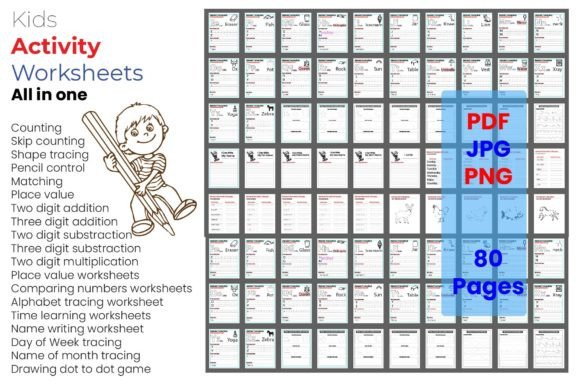
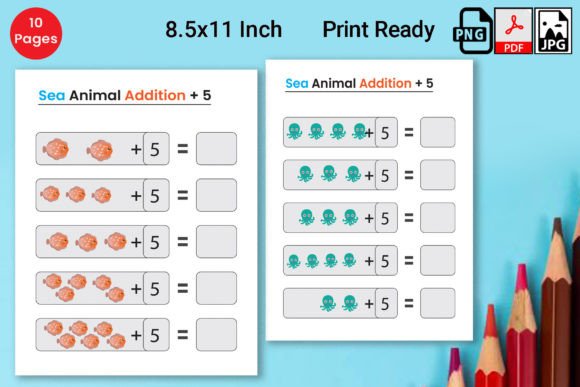
Today’s learning environments vary widely—from traditional classrooms and after-school programs to remote tutoring sessions and bilingual home instruction. The Kids Math Addition with 5 Worksheets interior was developed with this diversity in mind. The 10 PDF pages include both student-facing sheets and companion answer keys with teaching notes—helpful for new educators or parents unfamiliar with current math pedagogy. The 10 JPG and 10 PNG files allow seamless integration into learning management systems (LMS), presentation decks, or custom flashcard apps. PNGs, with their transparent backgrounds, enable easy layering onto themed backgrounds—think jungle animals for a “count the monkeys” activity or ocean scenes for “add the fish.” This modularity supports differentiation: a student needing tactile reinforcement can cut and paste counters, while another might annotate digitally using a stylus.
KDP-Tested Quality for Creators and Small Publishers
For independent creators, curriculum designers, or small educational publishers, production reliability is non-negotiable. This interior has undergone full Amazon KDP validation—not just for technical compliance (margins, resolution, color mode), but for real-world usability. That means no unexpected cropping on trim edges, CMYK-safe color palettes that reproduce accurately on standard printers, and fonts licensed for commercial redistribution. It also means metadata-friendly naming conventions—files labeled “Addition_Worksheet_3_Missing_Addend.pdf”—so creators can maintain organized digital asset libraries. Because the design avoids proprietary elements or embedded scripts, it integrates smoothly into existing branding workflows: swap out header graphics, adjust accent colors, or insert school logos without compromising layout integrity.
Supporting Inclusive Instruction Through Intentional Design
Inclusion isn’t an add-on—it’s embedded in how questions are framed and visuals are selected. The illustrations across the five worksheets feature ethnically diverse children engaged in everyday math moments: sharing cookies, stacking blocks, counting library books. No imagery relies on culturally specific assumptions (e.g., snowmen in tropical climates or holiday-centric themes). Language is concise and action-oriented: “Draw lines to match,” “Circle the sum,” “Write the number sentence”—phrasing tested for readability at early elementary levels. For English language learners, the consistent iconography (a plus sign always appears in the same size and position) builds visual literacy alongside numerical fluency. Even spacing between problems accommodates varied writing sizes—supporting students still mastering pencil control.
From Practice to Proficiency: Observing Growth Across the Set
What makes Kids Math Addition with 5 Worksheets especially valuable is its built-in formative assessment potential. Because the progression is calibrated—not arbitrary—teachers can observe shifts in strategy use across the sequence. A child who counts every dot on Worksheet 1 may begin “counting on” from the larger number by Worksheet 3. By Worksheet 5, they might decompose 8 + 5 into 8 + 2 + 3—a sign of emerging number sense. Educators can track this evolution informally, using the sheets as low-stakes diagnostics rather than graded tests. Homeschooling parents report that the predictable format reduces resistance: children recognize the “look and feel” of each session, building confidence through familiarity rather than novelty fatigue.
Real-World Applications Beyond the Worksheet
Addition fluency lays groundwork far beyond arithmetic drills. It underpins time estimation (“We have 7 minutes left—how many more problems can we do?”), measurement comparison (“This tower is 5 blocks tall; that one is 3—how much taller?”), and even early data interpretation (“Three friends chose apples, two chose bananas—how many chose fruit?”). The word problems embedded in later worksheets model these connections organically. One scenario asks students to add ingredients for a pretend recipe—linking math to life skills and sequencing. Another invites them to tally classroom attendance, reinforcing one-to-one correspondence in authentic contexts. These aren’t contrived “math in the real world” examples; they reflect routines children already navigate.
Technical Readiness Without Compromising Pedagogy
“Ready to print” sounds simple—but it implies rigorous behind-the-scenes work. Each PDF is pre-flattened to prevent font substitution issues, uses embedded subsets to keep file size manageable (<2 MB per document), and complies with PDF/A-1b standards for long-term archiving. JPGs render at 300 DPI for sharp letterforms, while PNGs preserve transparency for layered digital lessons. There are no hidden layers, password protections, or external dependencies—just clean, self-contained assets. This technical simplicity means less troubleshooting during lesson prep and more time spent on responsive teaching. Whether you’re printing 5 copies or 500, the output remains consistent. And because no bleed is used, there’s zero risk of critical content being trimmed off during binding or laminating.
Building Sustainable Learning Habits
Consistency in resource design fosters consistency in learning behavior. When children encounter the same clear structure week after week—same placement of instructions, same style of number formation, same visual cues for “start here”—they invest mental energy into the math, not decoding the format. That predictability supports executive function development: planning, working memory, and task initiation. Teachers using Kids Math Addition with 5 Worksheets across multiple cohorts note that students begin anticipating next-step prompts (“Now I need to write the equation”) before being prompted—evidence of internalized routine. Over time, this autonomy transfers to other subjects, reinforcing broader academic stamina.
Thoughtful Expansion Pathways
While the core set focuses tightly on addition fundamentals, its architecture invites natural extension. Educators regularly adapt the templates for subtraction practice by flipping the operation symbol and adjusting context language. Some use the blank number-line spaces for skip-counting warm-ups; others repurpose the object-counting grids for early multiplication arrays. Because the source files are high-resolution and modular, creators can extract individual elements—like the clean arrow icons or uniform number fonts—to build complementary resources: flashcards, wall charts, or digital drag-and-drop activities. This interoperability makes the interior not just a standalone product, but a foundational toolkit.
If you appreciate rigorously designed, classroom-validated educational materials—and value resources that respect both learner cognition and educator time—you’ll recognize the intention woven throughout Kids Math Addition with 5 Worksheets. It’s more than a collection of pages. It’s a reflection of how math learning unfolds: incrementally, respectfully, and with quiet confidence in every carefully placed numeral.